Search This Blog

Tuesday, 9 December 2014

Advent 7: Waiting for someone to stand in my place


“He was pierced for our transgressions,
He was crushed for our iniquities;
The punishment that brought us peace was upon him,
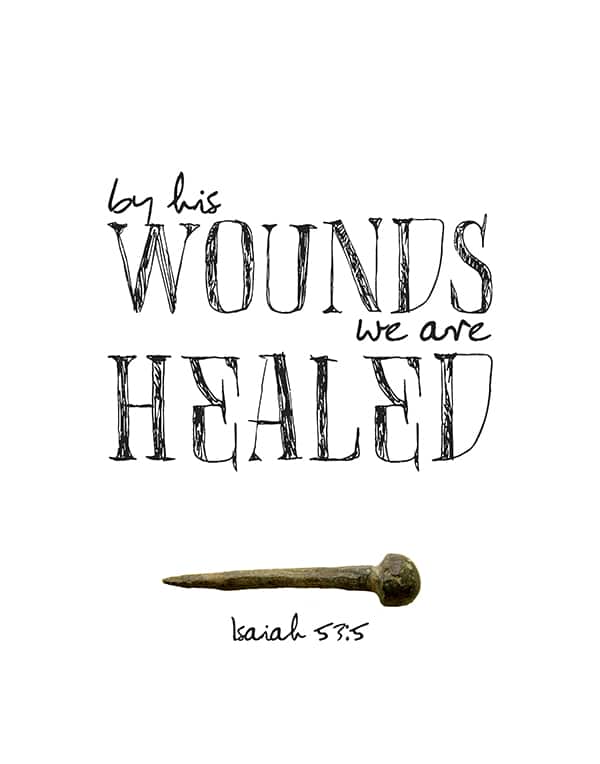
And by his wounds we are healed.
We all, like sheep, have gone astray;
Each of us turned to his own way;
And the LORD has laid on him
The iniquity of us all.” (Isaiah 53:5-6)

What does it mean that Jesus stood in our place?

In part it means that we needed Jesus to come. That is a sobering thought. It is easy to get tangled up in the tinsel of Christmas and forget that this tiny, little, beautiful baby would one day be nailed to a cross. Upon the shoulders of the man this baby would become would be placed the pain and wrongdoing and shame and brokenness of the whole world.

God’s story is that of a Father longing to be restored to his children. It is the story of a terrible rift that has been made become God and the people who have turned their back on him. The story of a perfect, good and holy God who is grieved by the way the world and the people in it hurt themselves and each other, who cannot ignore wrongdoing and yet loves those who do wrong.

Jesus came to stand in our place. I don’t know if I really believe that to be true. If I’m honest, I don’t think I deserve to die. I don’t want to believe that I really needed someone to stand in my place, to take away my sin for me because I couldn’t do it on my own. It was my sin that held Jesus to the cross. It was my rejection of God which caused Jesus to come down to help me to realise how beautiful the God was that I was rejecting. I needed him to become the perfect exchange. He became my perfect substitute. In the moment of crying out on the cross that His Father had forsaken him, Jesus took on my estrangement from God. He was rejected so that I could be brought close. He became Fatherless that I might know God as Father.

Reflection: Read the lyrics of the songs below and listen to them. Let us ask God to show us the beauty of the sacrifice Jesus made and the reason that he was willing to stand in our place: because he loved us.

You bled your heart out
Now I feel love beat in my chest
How wonderful
You gave your beauty
In exchange for my ugliness
How wonderful

You left your perfection
And embraced our rejection

How marvellous, how boundless
Is Your love, is Your love
How wonderful, sacrificial
Is Your love for me

You put on our chains
Sent us out through the open door
How wonderful
You took our sadness
Crowned us with joy and real peace
How wonderful

You left Your perfection
And fought for our redemption

Yes Jesus loves me
Yes Jesus loves me
How wonderful
Yes Jesus loves me
This is love
You gave Yourself
How deep the Father's love for us,
How vast beyond all measure
That He should give His only Son
To make a wretch His treasure

How great the pain of searing loss,
The Father turns His face away
As wounds which mar the chosen One,
Bring many sons to glory

Behold the Man upon a cross,
My sin upon His shoulders
Ashamed I hear my mocking voice,
Call out among the scoffers

It was my sin that held Him there
Until it was accomplished
His dying breath has brought me life
I know that it is finished

I will not boast in anything
No gifts, no power, no wisdom
But I will boast in Jesus Christ
His death and resurrection

Why should I gain from His reward?
I cannot give an answer
But this I know with all my heart
His wounds have paid my ransom







Sunday, 7 December 2014

Advent 6: Waiting for healing

God is a healer. It is part of his character, the heart of who he is. His name is Yahweh-Rophe, the God who heals you. When Jesus was on the earth he revealed God's character as a healer. John the Baptist, chained and desperate in prison, sent word to ask if Jesus was really the Promised One. Jesus' reply was that he must be because he was doing what only God's anointed one could do; he was healing:

"When John, who was in prison, heard about the deeds of the Messiah, he sent his disciples to ask him, ‘Are you the one who is to come, or should we expect someone else?’
Jesus replied, ‘Go back and report to John what you hear and see: the blind receive sight, the lame walk, those who have leprosy are cleansed, the deaf hear, the dead are raised, and the good news is proclaimed to the poor. Blessed is anyone who doesn't stumble on account of me." (Matthew 11:2-6)

Jesus quotes the ancient words of Isaiah back to John. In Isaiah 35, the picture is of a barren and weary land that is longing for rain. The promise is that one day, what is parched and dead will spring back to life, what is broken will finally be fixed, the wilderness will become an oasis. God's people are told to take courage; to strengthen feeble hands and faltering footsteps because the healing God will come. And when Jesus does come this is exactly what he does: his acts of healing as he walks the earth testify to the reality of who he is. He is the sent One. He is the waited for One with the power to heal and restore and make all things new.

What about us? What about now? God is the healer and yet we remain hurting. Prayers remain unanswered. Jesus came and he healed once, but what do we do when we ask for healing and it doesn't happen? Where is the Healer in among cancer, and miscarriage, chronic pain, and unfair death? 

I have no answers. I do not know why God sometimes heals and he sometimes doesn't. But the promise of Jesus as Healer is a promise that extends beyond this life. One day we will be healed. We will be fully restored. Our broken bodies will be made perfect. And in the meantime, Jesus works out an altogether deeper kind of healing. It is by his wounds that we are healed. (Isaiah 53:5). At the cross Jesus healed our relationship with the Father. He is not content with physical well-being; he wants it all fixed. Mind. Body. Soul. Spirit. That's quite an ambitious project. It cost Jesus his life. 

Reflection: Father God, help me to see what you have healed instead of arguing with you about what you haven't. Help me to trust in your healing character even when I don't see it. Thank you for Jesus and his healing work on the cross. Because of his wounds I am healed. Because of his blood I am washed clean of sin and shame. Because of his death I live. Amen. 

Advent 5: Waiting for peace

We live in a world that longs for peace. The newspapers scream of our need for it. When Isaiah, one of the prophets in the Old Testament, spoke of who Jesus would be, who the waited for one would be, he named him the "Prince of Peace." He said that in spite of all appearances, despite the violence and pain of the world as is, one day someone would come to sort it out. This man would be a great judge: he would settle the disputes that ravage nations and peoples. He would ensure that every boot used for battle, every blood-stained piece of armour, would be thrown away and burned because it would not be needed any more. (Isaiah 9:5) The people themselves would beat their swords into ploughs and their spears into pruning hooks. (Isaiah 2:4). On that day there would be no more war. No more armies. No more child soldiers. No more tears and grief. No more death. 

We do not live in that day. We live waiting for the fulfilment of that promise. We wait for the final day when Jesus promises to come back and sort things out once and for all. We live in the not yet. And it is painful. 

And yet, in the waiting, Jesus is still our Prince of Peace. He still offers peace to his people. As we pray for peace between nations, Jesus extends his own peace to us. He says to my anxious soul which frets about Christmas presents, and what people think of me, and whether my friend is going to be ok, about what my future is going to be like, and a thousand other unnecessary things everyday; he says "Peace be with you" (John 20:19).

He says, "I'm leaving peace with you even though you can't see me. I'm giving you the gift of peace and I'm giving it to you in a way the world can't. You don't need to be troubled. You don't need to be afraid any more." (John 14:27)

He says, "Do not be anxious. I am close. Come to me and talk to me about it. Leave it with me. And I will give you a peace that you don't understand, a peace that will keep you safe and calm your heart." (Philippians 4:5-7)

He says, "Trust me. I'm the rock. I'm the solid ground. I will keep you in perfect peace if you would just look to me. Trust that I am who I say I am and I want to give you the peace I say I can give you." (Isaiah 26:3-4)


Reflection: I want to know this peace today. I want my heart to be filled with it to the brim so that in the middle of any and every situation I am totally secure. Father God, please give me peace today. Give it to me in the way that only you can. Show me that my feet are standing on solid ground even when it feels like everything has given way. Amen


Thursday, 4 December 2014

Advent 4: Waiting to be comforted

Part of Jesus' job description is a comforter. He says that he has been sent "to bind up the broken hearted." (Isaiah 61:1; Luke 4:18-21) Healing hurting hearts was - and is - his mission; it was his reason for coming and it is what he is in the business of doing today. 

The Jesus that we see in the Bible is a man who is familiar with sorrow. He does not stand on the edge of human hurt. He is not a distant God who stands unmoved and observes us crying with cold and hardened heart. He wades right in and lives among us. He embraces the mess of life as a human being. He experiences the fullness of its joys and its pains. He walks amongst those who grieve and hurt and get angry. He kneels beside Martha and Mary in the dirt to weep with them over the death of their brother. (John 11:35) He is moved by compassion for the crowds of people who wander the streets. (Matthew 9:36) He stops what he is doing comfort a bereaved mother because his heart is pained by her loss. (Luke 7:11-16)

God's heart of compassion is perfectly revealed in his Son, Jesus. He is the Father of Compassion, the God of all comfort. (2 Corinthians 1:3) He longs to be welcomed in to our hurt. Answers still do not come easily: comfort is not an instantaneous experience; grief is not immediately stopped. But God is present in the middle of our pain. My anger often prevents me from acknowledging this. I am so busy being mad at Him that I refuse the comfort that is offered. I won't let God share my grief with me because I'm too busy blaming him for causing it. I am waiting to be comforted and yet I lash out at the one who tries to do it. But Jesus is persistent. Faithful. Unchanging. He will comfort us. If only we would let him.

Reflection: Father of compassion, I pray that I would know you in the midst of everything that today brings. I choose to acknowledge you in pain and in joy, in sorrow and in laughter. You are the comforter. Do not let me forget it. Do not let me cut you off from what I am going through. Do not let me block you out from my struggle, my questions, my doubt. I welcome you in today. I ask for your comfort today, for myself and for this world which so desperately needs it. Help me to know you as the comforter that you are. Amen. 

Wednesday, 3 December 2014

Advent 3: Waiting for a shepherd

A shepherd

"I will place over them one shepherd, my servant David, and he will tend them; he will tend them and be their shepherd." (Ezekiel 34:23)

Shepherd is a bit of a weird image for us Westerners and city people who don't really know what a sheep is unless it's given to us as a lamb chop. But, for Israel, God's promise of a shepherd was the promise of someone to look after them. It was the promise of someone to search out those who were lost and scared and lonely and bring them back; the promise of protection, of a safe place, of provision of food and water and everything they needed.


We have all had experiences of bad leadership: people running our countries in ways we don't agree with, decisions being made that aren't for our good, family members who were meant to look after us but hurt us, bosses who cared for themselves and for their pay cheques but for no one else. In the Old Testament, this has been the experience of God's people: their rulers, their shepherds, have been pretty awful. They've acted for their own good rather than for the good of the flock. They've made sure they're fed and happy and satisfied but left the people, the sheep, to starve.

But in amongst this mess, God speaks and he promises that one day He himself will come and will rule as a Good Shepherd. He will live amongst his people and they will know him and trust him and follow him. He promises that "as a shepherd looks after his scattered flock when he is with them, so I will look after my sheep. I will rescue them from all the places where they were scattered...I myself will tend my sheep and make them lie down...I will search for the lost and bring back the strays. I will bind up the injured and strengthen the weak." (Ezekiel 34:11-16). His promise is, ultimately, that he will prove himself to be this good shepherd by dying for those he loves. Jesus, the Good Shepherd, will lay down his life for his sheep.

Reflection: And so, today, no matter how lost or estranged or far from God we might feel, Jesus, the Good Shepherd, promises to look for us, heal us and to bring us home. Let us spend some time today listening to God - asking him to help us hear the voice of the Good Shepherd calling our names so that we can follow him.

Tuesday, 2 December 2014

Advent 2: Waiting for a king

"He is the one who will build a house for my Name, and I will establish the throne of his kingdom forever." (2 Samuel 7:13)

Hundreds of years before Jesus was born, his ancestor King David was promised that one day some one from his family line would become the eternal King. Unlike any other king, this king would rule forever. He would never be supplanted. He would never die. He would always be in charge, always be reigning.

If Jesus being a baby is offensive, then his claim to be the everlasting King is surely more so. At the start of the Christmas story, even before Jesus has done anything, his claim to be a King is already causing division. Herod's reaction to his birth is violent: he is so disturbed by the thought of someone coming to take away his own power that he orders the murder of all male children under the age of two. He is so afraid of someone else being in charge that he attempts to stamp out any future kings and he is willing to take any means necessary to do so.


And then we have the Magi, the wise men. In total contrast to the fear and angry of Herod, these powerful rulers are filled with joy at the thought of Jesus as their king. When they see him, they immediately bow down to worship him and give him gifts that are symbolic of the King he will become. Even though Jesus is just a baby, they recognise that what God said to Mary is true: here is one who will reign forever. 

What about us? How do we react to Jesus as King? We are not people who like authority. We love to criticise politicians and those in power. We want them to take the flack, we want them to sort everything out but, if I'm honest, I don't really want anyone to tell me what to do. I don't want anyone to make decisions that are going to affect my life and force me to change anything. But this is exactly what Jesus does: calling him King means putting him in charge. It means that today is not my own. My time is not my own. Calling Jesus King means joyful surrender; it means handing over to the one who promises to reign well and reign forever. Is that something I'm willing to do this morning?

Monday, 1 December 2014

Advent 1: What are you waiting for?

As I've prayed over the past few weeks, the question that keeps nagging me is "What are you waiting for?" Advent is a season of waiting, of expectation, of longing and hoping. In many ways it is a painful season: a realisation of prayers unanswered, of plans gone wrong, of hopes unfulfilled, of waiting for what hasn't happened yet. What are we waiting for? Healing? Employment? Reconciliation? Peace? Rest? Hope? Change? Something new? A fresh start in the New Year?

Baby by Anonymous - cartoon babyFor those who follow Jesus, Advent is the season of remembering that Jesus is the one we waited for; he is the one that all of history waited for. The hope of humanity is met in him. And so each day during Advent I'm going to post a short thought on what it is exactly that we waited for. What were we waiting to arrive that first Christmas morning thousands of years ago? 

We waited for a baby. 


"The Lord himself will give you a sign: the virgin will be pregnant." (Isaiah 7:14)

This is perhaps the most insane and offensive part of the Christmas message - that all of history was waiting for the arrival of a tiny, fragile, helpless baby. A child who, like any other child, would be absolutely dependant on his mum, who would wake screaming and crying in the middle of the night, who would need his nappies changed, who would need feeding and bathing and loving. In the midst of tinselly nativities it is easy to forget that Jesus was like any other newborn: red-faced, wrinkly and crying out for love. 

Our God is a strange God. The birth of a baby seems the most ridiculous way to start a plan to save the world but this is what we're about to celebrate. God's Son was born in an obscure, forgotten part of the world to a teenage Mum. He was born into poverty and scandal. Let's not gloss over the mess of that first Christmas this Advent. Our God is a God who embraces mess - his plan to save humans started by becoming one. 

Reflection: Think about the smallest baby you've ever held. Think about how totally vulnerable and helpless he or she was. Ask God why he chose to become a tiny baby: What did he want to show us by choosing to come into the world not as some great hero or warrior but as a child? Thank God that he doesn't do things in the way we expect. He is the God of the little people!