Search This Blog

Friday, 15 January 2016

Scarcity


What we have is enoughand more
If we lack anything, it is the
simple pleasure
To enjoy what we already possess.

Mark Scandrette

Last night, I had a panic about our moses basket.

We had been given a beautiful basket by a friend but for some reason, yesterday, I was suddenly anxious that it wouldn’t be appropriate. What if the mattress was too old and therefore not firm enough? Did we even have the right bedding to go in the basket? Were we supposed to be using those sleeping bag things or blankets or both? The list of questions in my mind spiralled endlessly.

Similarly, a few weeks ago I had a panic about the ‘coming home’ outfit from the hospital. We live in a ridiculously and extravagantly generous community and have been given more baby outfits than one tiny child can ever possibly wear, some brand new and still in their wrapping, ranging from tiny baby all the way up to about 12 months. But I was suddenly overcome by the fear that we had nothing suitable for our poor naked daughter to wear.

You could simply blame such irrational thinking on being heavily pregnant. But I think there is something much deeper going on. I think what I am actually afraid of is much bigger and much more consuming: I am afraid that I do not have enough.

In her book, The Soul of Money: Transforming Your Relationship with Money and Life, Lynne Twist identifies this condition as something she calls scarcity.

“For me, and for many of us, our first waking thought of the day is "I didn’t get enough sleep." The next one is "I don't have enough time." Whether true or not, that thought of not enough occurs to us automatically before we even think to question or examine it. We spend most of the hours and the days of our lives hearing, explaining, complaining, or worrying about what we don't have enough of... Before we even sit up in bed, before our feet touch the floor, we're already inadequate, already behind, already losing, already lacking something. And by the time we go to bed at night, our minds are racing with a litany of what we didn't get, or didn't get done, that day. We go to sleep burdened by those thoughts and wake up to that reverie of lack... This internal condition of scarcity, this mind-set of scarcity, lives at the very heart of our jealousies, our greed, our prejudice, and our arguments with life.”

We live in a culture that constantly – in both obvious and not so obvious ways – tells us that we do not have enough. Most obviously, this applies to our relationship with wealth and material possessions. We simply do not have enough money. We do not have enough stuff. We need the latest, the newest, the most expensive model of just about everything. And we are told this every day from every angle. But, more subtly, this way of thinking filters down into the way we think about other things too: We do not have enough confidence to do that; we do not have enough patience to refrain from shouting at our children; we do not have enough time to invest in the relationships that matter.

I think this way of thinking must make Jesus really sad.

In Twist’s book she describes the remedy to scarcity as “the surprising truth of sufficiency.” Sufficiency is not a set amount of anything; it is “an experience, a context we generate, a declaration, a knowing that there is enough, and we are enough…it is a consciousness, an attention, an intentional choosing of the way we think about our circumstances.”

Jesus takes this even further. In the economy of the kingdom, the remedy for scarcity, for thinking that we do not have enough and are not enough, is not sufficiency but abundance. Our God is stupidly generous. He is our provider and he delights in being so. In Beautiful Outlaw, John Eldridge draws attention to the first miracle of Jesus as listed in John’s gospel: turning water into wine at a wedding. This is a miracle of extravagant, abundant and (quite frankly) unnecessary generosity. Eldridge explains that Jesus produces the equivalent of 682 litres of wine. That’s 908 bottles. And this is at the end of the wedding. Presumably the party was going to tail off quite soon - or at least it was until Jesus provided an excessive amount of booze – but now it is party time all over again. 908 bottles’ worth of party. And this is “the first of the signs through which [Jesus] revealed his glory; and his disciples believed in him.” (John 2:11)

What is it exactly that the disciples believed at this point? That Jesus liked to party? That he was a miracle-maker? A problem-solver? I have no idea what they were thinking, but something about this outlandish gesture of generosity gets their attention. They start, in some way, to put their trust in him, to believe that, maybe-just maybe, he is who he says he is. He is God. And he is the God who loves to give gifts to his people. He is the God who longs to look after them and be trusted by them. He is the God whose deepest lament is that his people have forgotten who he is (Jeremiah 2:32, 18:13-15) and started to trust in anything, everything, else apart from Him.

Much later on in John’s gospel, Jesus reminds his disciples of his trustworthiness. He is about to leave them. He is about to go to the cross and die and he needs them to know that he can be trusted. He is who he says he is. The sorrow of this difficult and confusing conversation is (understandably) too much for the disciples. They are filled with fear and dread about their precious Jesus leaving and, when Jesus tries to reassure them that he is going ahead of them in order to prepare the way for them, they start to panic:

“Thomas said to him, “Lord, we don’t know where you are going, so how can we know the way?”
Jesus answered, “I am the way and the truth and the life. No one comes to the Father except through me. If you really know me, you will know my Father as well. From now on, you do know him and have seen him.”
Philip said, “Lord, show us the Father and that will be enough for us.”
Jesus answered: “Don’t you know me, Philip, even after I have been among you such a long time? Anyone who has seen me has seen the Father. How can you say, ‘Show us the Father’? Don’t you believe that I am in the Father, and that the Father is in me?” 
(John 14:5-10)

In my mind – and without wanting to superimpose too much onto scripture – there is deep sadness in Jesus’ reply to Philip: “Don’t you know me…even after I have been among you such a long time?” I imagine Jesus locking eyes with his friend and gently saying, Do you still not trust me? Even after all you’ve seen? Even after all the provision I’m made for you? Even after the feeding of multitudes, the calming of storms, the steadiness of me being with you; even after all that, you still don’t trust me.

This morning, as I reflected on my moses basket panic, I felt God ask me the same question: why don’t you trust me?

Mark Scandrette raises the same question in his reflections about how we really, practically live out the teaching of Jesus in an age where His commands have become counter-cultural and seemingly nonsensical. It does not make sense to not be anxious about anything (Matthew 6:25). There seems like a very great deal to be afraid of (John 14:27), and we feel the overwhelming need to cling to what we have rather than be generous to others (Luke 12:33, 16:9, Matthew 6:19-20).

And yet, we like Philip, must make a decision. We must “shed our sense of scarcity” (Practicing the Way of Jesus: Life Together in the Kingdom of Love p.140) and instead choose to trust in the abundant provision of a loving, heavenly Father who knows our every need and longs for us to ask Him to fulfil them. Scandrette warns “if we don’t make conscious choices about our relationship to money and possessions, the forces of a dominant culture will tend to make those choices for us.” (p.144) The dominant force of this culture tells me that I need a new moses basket. I probably need two moses baskets actually. Just in case.

But the Way of Jesus is not the way of culture. Jesus invites us to trust. His is an invitation to live in God’s abundant provision regardless of whether we actually have plenty or not. An invitation to trust that He is enough. His grace is more than we need – not just for our material wellbeing but for our emotional and spiritual wellbeing too. Thus, today’s small step is a response to that invitation: to stop worrying about what we do not have, or might not have, and instead delight in the simple pleasure of enjoying all that we already possess. 

Wednesday, 30 December 2015

Joy and Sadness

Two things have impacted me quite profoundly in the past month: the first, somewhat ashamedly, is Pixar’s Inside Out; the second is Brene Brown’s thinking about vulnerability. Hamish and I watched Inside Out together a few weeks ago.

I bawled.

Not just those little corner-of-the-eye-tears that can be hastily mopped up, but shoulder-shaking sobs reminiscent of those induced by the first five minutes of Up.

I could blame being pregnant and hormonal (and did), but I genuinely think that Disney’s portrayal of Joy and Sadness touches on something pretty deep within the human condition.

In the film, Sadness’s character is ostracised by the other emotions (Joy, Disgust, Anger and Fear) in Headquarters (the brain of 11 year old Riley). No one can quite see the point in her existence. All she does is make things, well, sad, tainting everything she touches with her blue aura of depression. At one point, Joy even draws a chalk circle and shoves Sadness inside it in a desperate attempt to stop her from contaminating Riley’s memories.


The film takes Joy and Sadness on a journey together through the murky recesses of Riley’s brain until – finally – Joy starts to understand that Sadness has a function. Tears are not inherently bad. Crying is not simply something to be swept under the carpet. Some of our profoundest, and most beautiful, experiences in life are possible only because we experience painful emotion. 

This is not something that I like to admit.


I don’t like being sad. I hate crying. Especially in front of other people. And, most of the time, I wish I could just hide my sadness in a corner (or a chalk circle) and ignore it completely. We don’t want to engage with things that are hard and painful or complicated so – for the most part – we don’t. We do what Joy does to Sadness in Inside Out: ignore, avoid and try to get a handle on it. 
A couple of years ago, I was really struggling with being sad. I can’t quite explain where the sadness came from, but I was just quite sad. It was difficult to talk to other people about because I didn’t really feel like I had a legitimate reason for being sad. Nothing particularly awful or tragic had happened. I just felt down. Life felt grey and slightly pointless and even though the things that I knew to be true were still true (God loved me; Hamish loved me; my friends and family loved me), I couldn’t shake the feeling that perhaps they weren’t. I didn’t know how to explain it and was ashamed to try with most people because I feared their judgement or – worse – their helplessness. I didn’t want to superimpose my sadness onto other people in case they felt like they had to try and do something about it, and then felt bad when they couldn’t.

I have deleted and re-written that last paragraph several times because it isn’t something I have admitted to many people and, if I’m honest, I didn’t really have any intention of admitting publicly on a blog. But that, I think, is precisely the point: we don’t know how to talk about sadness. We don’t know what to do with not being ok, and with other people not being ok, so we don’t do anything. Ignore. Avoid. Get a handle on it. That is our strategy.


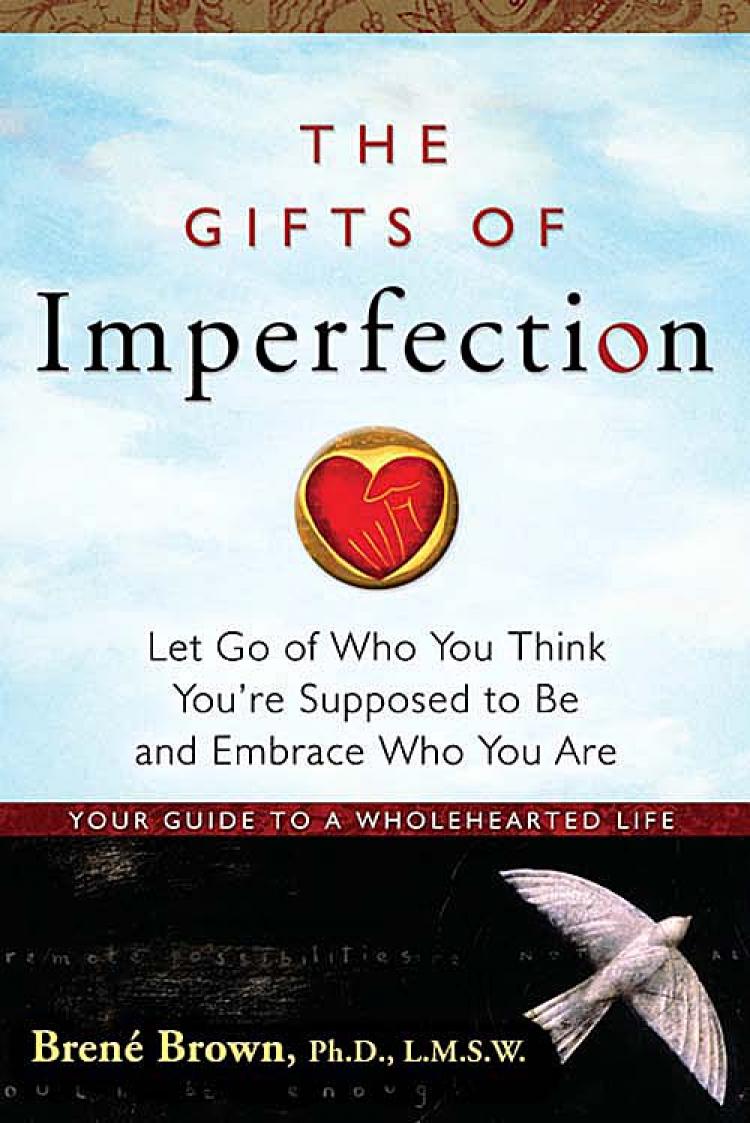
Which brings me to Brene. A friend recommended one of her TED talks a long long time ago, but I had forgotten about it, and then, last week, my friend Izzy lent me her book, The Gifts of Imperfection. I consumed it in about three days. I can’t do the book justice now, and am hesitant to reduce Brown’s research too much through summarising, but what resonated most with me was Brown’s insistence that when we try to avoid (or numb – her word) the painful emotions of life, we limit our capacity to really feel life’s beautiful emotions. 
She writes, “The most powerful emotions that we experience have very sharp points, like the tip of a thorn. When they prick us, they cause discomfort and even pain…for many of us our first response to vulnerability and pain of these sharp points is to not lean into the discomfort and feel our way through but to make it go away. We do that by numbing and taking the edge off the pain with whatever provides the quickest relief.” (The Gifts of Imperfect, p.70)
All of us have our own “numbing” strategies: the more obvious addictions of alcohol, drugs and food; and the more subtle ones of work, Facebook, perfectionism, and busyness. We use these strategies to cope with pain, with sadness, with thorny feelings that we aren’t sure what to do with. But, and this is the part of Brown’s research that surprised her, when we do this, when we take the edge off our sadness, we dull our capacity to experience joy: “There is no such thing as selective emotional numbing. There is a full spectrum of human emotions and when we numb the dark, we numb the light…joy is as thorny and sharp as any of the dark emotions. To love someone fiercely, to believe something with your whole heart, to celebrate a fleeting moment in time, to fully engage with a life that doesn’t come with guarantees – these are risks that involve vulnerability and often pain. When we lose our tolerance for discomfort, we lose joy.” (pp.72-73)
I think this is true.

I don’t quite understand why it is true or why we react this way, but I think it is. I recognise in myself the fear of being joyful (which I know sounds paradoxical). Sometimes I am afraid to allow myself to be truly happy. I am afraid to give in to the joy and beauty and wonder of a moment because – in doing so – I acknowledge that the moment might pass, that joy might be lost, that it is transient and unpredictable. Denial becomes a bizarre process of self-protection: to not be joyful is less costly than being joyful and having that joy snatched away. 

In Inside Out, Joy cannot tolerate Sadness. She is terrified of allowing sadness to infiltrate what could otherwise be happy. We do the same thing but, in doing so, we allow our fear of what might be lost to prevent us from ever truly enjoying the thing in the first place: “We’re afraid to lose what we love the most, and we hate that there are no guarantees. We think that not being grateful and not feeling joy will make it hurt less.” (p.82)

Again, I know that I do this. I put a dampener on joy. I cut it off lest it get out of hand and something else cut it off instead. Withholding from myself the full experience of how good and joyful something actually is is my own peculiar self-preservation. It protects me from the potential vulnerability of someone else poking fun at my joy, at my joy being popped and ending up in a heap on the floor.

It is also not very fun.

As ever, I don’t write these things with answers or dogma or solutions. I try and write them with honesty. I want 2016 to be a joyful year, a year in which I cultivate and practice joy and allow myself to feel it. A year in which I am grateful and thankful and celebrate and dare to enjoy the goodness of moments even though they will fade, or perhaps precisely because they will. This does not mean that 2016 will be a year without sadness or hurt, but it is a year in which I want to resolve to allow myself to be joyful: to dance around the living room even though I look silly, to laugh too loudly in places where I shouldn’t, to drink in the moments of our daughter growing up in awe and wonder without fearing about her future, to live, as Brown suggests, wholeheartedly.

Wednesday, 9 December 2015

Gain

It is difficult to write about death without being morbid. Or complacent. I do not wish to be either of those things. Death is a painful reality for all of us. Especially at Christmas. This is a time when we remember those who used to be with us, when we look back at old photos of Christmas dinner tables that looked very different, when we grieve for those that we miss.

This is good and right. My friend Inge died at Christmas time, and advent is tinged by the sadness of her passing. This time of year reminds me that she isn't here. And that I miss her. Sometimes that missing is a light and beautiful nostalgia; at other times it is the heavy pain of loss. I feel like I might drown in it.

Jesus understood grief. He wept. (John 11:35) When Jesus' friend Lazarus dies, he does not shrug off his death as though it does not matter. Even though he knows that he will raise Lazarus from the grave, he weeps alongside Mary and Martha as they mourn for their brother. He is moved by the sight of their pain and their grief, and he stoops down into the dust so that he can share in it with them. Our God is not unaffected by our pain. He is with us in the midst of it. As we hurt in this hurting world, we are confident that God hurts with us.

But Jesus does raise Lazarus from the dead. There is not just empathy in this story. There is power. There is a hope that transcends death and goes beyond the grave. Death is not the end.

Last week, Hamish reminded me of 1 Peter 3:15, "But in your hearts revere Christ as Lord. Always be prepared to give an answer to everyone who asks you to give the reason for the hope that you have. But do this with gentleness and respect." My instinctive response to this verse, to a querying of my own hope, is to focus on the hope that I have for this life: hope that no one is beyond the remit of God's grace, hope that transformation is possible in the hardest of hearts, hope that lives can be healed and made whole in the here and now, that God will break into the darkness and bring his beautiful light.


And I do hope for these things. I do hope to see God's goodness in the land of the living (Psalm 27:14), to see God's kingdom come on earth, to catch glimpses of the new creation now.

But last week, my friend's Dad also died. I did not know him well. I had only met him once, at her wedding. His death has challenged my understanding of hope. It has not lessened the hope that I have for this life, but it has reminded me that, ultimately, what Jesus promises us is hope for the next.

As I read Philippians 1 with my god daughter last week, we came to Paul's assertion that 'to live is Christ, to die is gain.' It is easy to gloss over this verse. It has become somewhat sentimentalised, converted into an iconic tattoo that looks good when your sleeves are rolled up but - perhaps - doesn't really mean anything. To Paul, it meant everything. There is nether morbidity nor complacency in his view of death. He does not want to die. He prays that, if it happens, he would be given the courage to face it without being ashamed, and yet he is utterly convinced that death is gain. To die means being with Jesus and that is a whole lot better than his current circumstance hauled up in a prison.

Perhaps these words are easier to write in a prison cell than in the midst of my life. Heaven does sound preferable to chains and misery (although, interestingly, Paul determines that he will live rather than die such is his concern for those whom he has started to tell about Jesus) but, what about me? Do I view heaven as better than what I have at the moment? Better than the joy of an imminent new life; better than friends and family and laughter and the sound of birds singing at dawn; better than watching the sun sink slowly in a haze of pinks; better than the taste of slow-cooked roast lamb; better than the feeling of falling asleep in safety and comfort beside the one that you love.

To live is Christ. To die is gain. His love is better than life. (Psalm 63:3)

For us in the West there is more challenge here than comfort. For our persecuted brothers and sisters suffering under tyranny in Iraq, it is surely the reverse. For those that know the reality of incredible pain and grief, immense pressure and horror, death is gain. To be with Jesus is, as it was for Paul, better. 

I do not know what to do with these words this morning. 

In moments of doubt, of which there are many, I question whether I actually believe in heaven at all. Whether I actually believe in an eternity with Jesus that surpasses any earthly experience, an eternity that would make any sacrifice or suffering or loss for the sake of Christ worth it. Do I actually believe in the bodily resurrection of those who have followed Him? That, in the twinkling of an eye, we are changed, we do meet him, and each other, caught up in the glory of his presence? 

And then I think of Inge. And I think of her dancing. I think of her body free from pain and healed of every trace of cancer. I think of her as a young woman, even though I never knew her then, with arms outstretched in praise, laughing, giddy with the joy of abandon and surrender. And somehow, this is enough. My weak faith is cemented by the certainty she had - even if I cannot claim it fully for myself - that the hope that we have is hope of resurrection. 


Tuesday, 8 December 2015

Are you listening?

Are you listening?
Excuse me.
I. Said.
Are. You. Listening?

The sharp sound of teacher’s disapproval
The did you hear what I just said?
Quit your daydreaming
Your misty eyed glaze
Your what if what next where to anywhere but here
And listen.

Today
A different voice

Quiet
Strong
Persistent
Gentle

Are you listening?

The voice calls my name

Insistent but not invasive
Easily mistaken for something else
Crowded out by Starbucks’ Christmas Carols
The buzz of busy thoughts
To dos and have dones and whoops I forgot
The voice fades
Slips away
Hidden once more
But still there

Quiet
Strong

Persistent
Gentle

Are you listening?

Not a demand -
a request
Can you spare a minute?
Can I trouble you for a moment of your time?
Can you just… stop?
Stop.
Be still.
Be still. And Know.
Know that I am here.
Know that I am.
I am the One who knows your name.
And you know my voice.

Are you listening?

Tuesday, 1 December 2015

A Stress Remedy

The meaning of Advent has been somewhat lost: hidden under piles of to do lists, Christmas decorations, brightly coloured adverts demanding that we yield to their tempting offers and a rather large dollop of stress as we consider how exactly Aunt Mabel is going to avoid making a slurred and offensive comment across the turkey under the influence of too much Sherry.

Advent is a season of preparation, but it's not entirely clear what we are preparing for. There is a somewhat daunting pressure for this December 25th to surpass the extravagance of last year: for better presents, crispier roast potatoes and happier family members. We struggle against the tide of consumerism and, despite our best efforts, succumb to buying presents that aren't really needed. Then berate ourselves for doing so.

I hate that I give in to festive stress.

A phrase that has been bothering me for a few weeks is "make room." There was "no room available" (Luke 2.7) for Jesus when he arrived. He came to us but we were too busy, too warped by our own needs and preconceptions, to notice him, too preoccupied to receive him as the precious and beautiful gift that God intended him to be. (John 1.10 - 11). I don't want to be too busy this Advent. I don't want to miss all the beautiful gifts that God has given because I am panic present shopping.

And so, this year, we gathered our little Sunday lunch community together to "make room" for others this Advent. We sat and prayed and planned, a subversive collective trying to wage war against consumerism. Wide-eyed and giggling, we determined to so some serious baking: to secretly present a little bag of edible goodies on the doorstep of someone in our community each day of Advent, to show the love of God through gingerbread made with sticky fingers and tags smothered in PVA glue and glitter. To surprise our friends with a reminder that they are loved and special and that we want to "make room" for them amidst our own busy lives.

Today is Day One. I'm pretty excited to wait for the stories to start piling in; for surprised statuses on Facebook as people celebrate being celebrated and, for a moment, forget about their to do lists.

As a remedy for festive stress, I can highly recommend it.


Tuesday, 17 November 2015

Cracks

Emotions are an odd thing. They sneak up on your unawares. An unexpected incident on a TV programme reduces you to a blubbering wreak; a minor misjudgement by a fellow driver leaves you spitting feathers and muttering expletives Mutley style under your breath. A couple of weeks ago, I burst into tears all over my slightly bemused husband because I’d forgotten to book an antenatal class and thus concluded that I was going to be a terrible mother. It’s not logical, but it’s certainly how we seem to function. Or at least how I seem to function.

And my immediate response is to withdraw. When circumstances are hard and the pressures of life overwhelm me, I want to run away. I want to seek an easier alternative. Perhaps if we have two cars instead of one then life will be easier. If Hamish had a different job then we could spend more time together. If I swapped community work for a nice little job in a private school then I wouldn’t be such a colossal stress head. There is probably some truth in all of these things but I think I am learning that to exchange one thing for another in the hope that life will be better; to ache for a new season because this one is hard is sometimes my way of ignoring the actual issue. Chesterton’s wry word, when asked what was wrong with the world, return to me: “I am.”

My friend likened it to the following picture: if something is cracked and you put pressure on it, the cracks will – of course – get bigger. But, if you remove the pressure the cracks won’t go away. You can pretend that they are not there, gloss over them with a change of situation, but unless you address the root cause of the cracks they aren’t going anywhere. Kind of like subsidence in a house. You can pretend the ground isn’t unstable by building a beautiful mansion smack bang on top of it but, the truth will out: the house will fall down. Eventually.

There is a profundity in Jesus’ simple story of the wise and foolish builders. (Matthew 7:24-27) Both builders face the same problem: there is a massive, great big whopping storm. The first builder, the one who builds on the rock, isn’t safe because there isn’t a storm; he’s safe because he took time to address his foundations. I’m sure the second builder blamed the storm for his house falling down, but the storm wasn’t really the issue. His building style was. I’m sure he blusteringly protested that it wasn’t really his fault: how could he predict a flood? How was he to know that it would be supremely windy that day? Is any house really expected to withstand that kind of pressure? But Jesus is, as ever, uncompromising: the house fell down because of mistakes made long before the storm even made an appearance.

I feel those same red-faced protestations rise up in me: the reason why I snapped at Hamish was because I’d had a hard day; the reason why I’m stressed is because there are difficult things happening and they are stressing me out; it wasn’t really my fault that I got so irrationally annoyed by someone else’s poor driving because, well, they should learn how to drive properly shouldn’t they?

Cracks. Cracks cracking into bigger cracks. Cracks splintering out of control. Cracks that suddenly, without warning, become visible on the surface.


I did a bible study last week with one of my god daughters. I love reading the bible with her. I love it because she’s so practical, because, for her, there really is no point in reading God’s word unless she responds to it and unless it makes a difference. We read the start of Philippians together. After about three sentences, I was convinced that this had been a bad idea. It’s a beautiful letter, but it’s complicated. There are lots of long words and hard concepts and, as we read, I was distracted by thinking about how to simplify the message, how to make it accessible; I was so busy thinking of all the possible things that might make comprehending the passage tricky that I missed the blindingly obvious thing about Paul’s letter: he is stupendously, ridiculously, happy. Leah got it straight away: he’s pretty happy, isn’t he? He’s in prison but he’s happy. Well, yes. Yes, he is. And it is – now that you come to mention it - completely mad. His circumstances do not exactly strike you as being joyful; after all he is penning the words whilst chained up to a prison guard. And yet, he is thankful (1:3), joyful (1:4), confident (1:6), optimistic (1:12). He interprets his situation in a way which, to most of us, seems utterly bizarre.

If ever a crack was going to show its ugly face, it would, surely, be at this moment. But there is not a crack in sight. I do not say that because I think that Paul was super human. I’m sure that, at times, he was desperate, hurting, weeping, confused and angry like the rest of us. But he’d paid some pretty serious attention to his issues, to his foundation, and now, in the most extreme and awful of circumstances he acts with love and grace. He praises God for his chains. This man is able to sing songs in the darkest places. (Acts 16:25)

Oh, how I crave to be like this. But to do so means taking a look at those cracks. The small ones. The tiny little fault lines that I like to pretend don’t exist. It means recognising that, if I am angry, then that anger is not only a response to my circumstance. That anger has been lurking unaddressed. That anger is to do with a poorly built foundation. The smallest provocation, the first indication of storm clouds, will reveal it for what it is.

What, then, is the remedy? Paul says that he has learned the secret of being content in any and every situation. (Philippians 3:12) That the only way to deal with your cracks is to make sure that you know the master-builder, to know that Jesus is with you and is in you, to depend on his strength in your weakness, on his calm in your storm, his peace in your anger. I do not think this is something that happens automatically. I think it is something that you have to practice. We can call on Jesus’ name in a desperate moment and plead with him to help us to respond in a proper and godly way (thank goodness). But if our actions are to become increasingly like his regardless of the pressure of our circumstance then we need to get into the habit of hanging out in his presence, of recognising, acknowledging (Hosea 6:3) that he is present in us (Colossian 1:27), and that his presence makes all the difference.

It is not the storm that causes the house to fall; it is the way that the man has prepared for it. It will not be pain or suffering or situation that causes us to crack – for we cannot be spared from those things (1 Thessalonians 3:3) – it will be whether or not we truly know the one who stands with us in the midst of them. Whether or not we have trained ourselves (1 Timothy 4:8) to remember that He is present. Whether or not we have laid down a solid foundation.


They will be like a tree planted by the water that sends out its roots by the stream. It does not fear when heat comes; its leaves are always green. It has no worries in a year of drought and never fails to bear fruit. 
(Jeremiah 17:8)

The Lord will guide you always;
he will satisfy your needs in a sun-scorched land
and will strengthen your frame.
You will be like a well-watered garden,
like a spring whose waters never fail. 
(Isaiah 58:11)


Tuesday, 27 October 2015

Dullness

Jesus can be rather blunt. We might consider some of the techniques he uses to challenge his disciples somewhat inappropriate if he wasn't the one using them: "Are you so dull? (Mark 7:18) "Are you still so dull?" (Matthew 15:16) These are hardly words of encouragement; this is exasperation.

One day last week, I was driving down a road that I have driven down a thousand times when I was suddenly overcome by the sheer beauty of the world outside my car. That sounds a little melodramatic but, for a few seconds, I was completely flummoxed by the radiance of nature, by the fire of autumn trees, the brilliance of blue sky, the golden glow of a low sun. A sense I had forgotten I possessed was awakened. For a few moments, a veil was lifted and creation was what it is always is: a canvas displaying the glory of God. (Psalm 19:1) How is it that I usually miss this? Am I so dull? 

For I think this is what Jesus is getting at: his anger is not that of a teacher infuriated by a student's innocent mistake, but by the inability of his disciples to spot the blindingly obvious. The word translated as dull on both the occasions that Jesus uses it is asynetos. It doesn't simply mean foolish or stupid or without understanding - although it carries hints of all these things - but, more properly, it describes a person's failure to structure information in a meaningful way and therefore reach the necessary conclusions. 

And so, Nic, on an average day, walks around and sees the skies and the leaves and the colours and the stars and the glaringly brilliant beauty of creation and doesn't think to praise God for it; doesn't think to offer up gratitude and thanksgiving to the one who created it in the first place. I have all the information needed and yet, somehow, I don't structure it meaningfully; instead the moments pass me by: I arrive at the shop and get distracted by what I've forgotten to put on my shopping list; I start thinking about something insignificant and petty and unimportant and... the moment has passed. Dullness.

And the worse thing about this state of dullness - lay aside for a second the potential arguments about whether nature does or does not prove the existence of God - is that it is void of joy. It misses the opportunity to celebrate, the opportunity to drink in life and savour its sweetness. It substitutes the thrill of childlike wonder for the stern, busyness of adulthood: "We get so preoccupied with ourselves, the words we speak, the plans and projects we conceive that we become immune to the glory of creation...we never think and blink about the bounty of God's creation. We grow complacent...we miss the experience of awe, reverence and wonder." (Brennan Manning, the Ragamuffin Gospel)

I don't want to miss out.

And this, again, is where I think Jesus' exasperation comes from: he doesn't want us to miss out either. He doesn't want us to walk through life blinkered to the reality of a world that was meant to display his beauty; he doesn't want us to shut our ears to the whisper of his voice and ignore invitation to walk alongside him. There is pleading in his rebuke: don't be dull. Wake up. Open your eyes. See the world differently. Experience wonder.

As I prayed for the young people that we took away to Fort Rocky, a Youth for Christ event, this past weekend, I was reminded of my experience in the car, of the lifting of that veil and the boundless joy of seeing the fingerprints of the Creator in the marvel of creation. My longing for our young people is that they would know that same joy, that, somehow, their senses would be awakened to the possibility of God's love for them, to his tangible presence in their lives.


In 1 Thessalonians, Paul entreats his readers to be those who are awake: "You are all children of the light and children of the day. We do not belong to the night or to the darkness. So then, let us not be like others, who are asleep, but let us be awake and sober." (1 Thess 5:5-6) The reference to sobriety is interesting. I don't think it means boring. This is not a call to be sombre and lifeless; it is the opposite: a plea to be fully alert, to not have our senses deadened. The issue with drunkenness is that it dulls us; we are dulled to the goodness and the nearness of God when we don't know what we are doing. Hence, the cry to get drunk on the Spirit instead (Ephesians 5:18). Get drunk on what will keep you wide awake; not what will make you sleepy.

Paul uses similar language as he writes to the Ephesians: your minds used to be darkened. Your senses used to be asleep. You had lost spiritual sensitivity and thus couldn't see God's nearness. (Ephesians 4:18-19) But now you are awake! Don't fall asleep again. Don't become numb. Don't stop noticing the beauty of this world. Don't stop expressing a childlike awe at the God who would speak to us through his creation and want to share its wonders with us.

This is not so much a rebuke for others as a prayer for myself. I do not want to walk through this world and miss out. I do not want to be deprived of joy because I have failed to thank God for all the goodness that is so beautifully on display. (Romans 1:20-21) And so, wake up, sleepy head. And let the light of Christ shine. (Ephesians 5:14)